

Operators’ most pressing commercial challenges for 2026 continue to evolve, with new network technologies such as 5G SA and VoLTE, industry disruptors Travel eSIM, and the importance of Quality of Service requiring operators to optimize their billing and settlement.
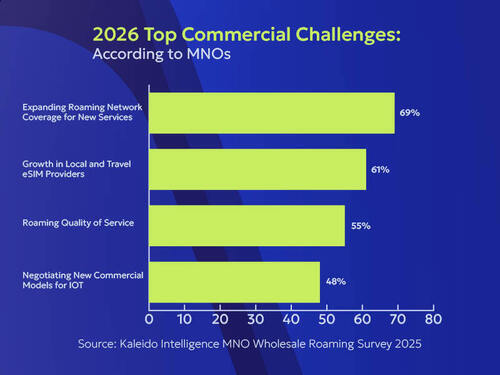
Operators today are faced with more commercial pressure than ever before, as their margins are pulled thin by necessary investments in network technologies, alternative communication channels, and increasing complexity in managing and optimizing discount agreements, among many contributing factors. A recent survey conducted by Kaleido Intelligence found that the most important commercial challenges according to operators are:
- Expanding roaming network coverage for new services, including 5G SA and VoLTE
- Growth in local and travel eSIM providers
- Roaming quality of service
- Negotiating new commercial models for IOT
Expanding Roaming Network Coverage for New Services
5G Standalone (SA) traffic is surging, 2G/3G networks are phasing out, VoLTE has already arrived, and the number of IoT-enabled devices has grown drastically. Operators are under pressure from both subscribers and enterprises to modernise their roaming services. These modern offerings come with far more complex charging and billing data requirements, shifting from traditional volume-based models to IMSI-based charging, network access fees, or QoS and SLA-driven mechanisms. This is beyond what TAP, the legacy billing system designed for voice, can handle.
Billing & Charging Evolution (BCE) is the modernized billing system, which was created to handle the vast amounts of data required to properly rate and charge traffic from new services like 5G SA. MACH’s convergent billing system, One Agreement, combines the legacy TAP system with the updated TAP0 (a method to simplify the adoption of BCE by removing the need for complex DDR creation, instead re-using the existing TAP process to exchange BCE-related data with roaming partners), the modernized BCE, and Inter-Operator Tariffs (IOT) into one unified platform. This future-proof system enables operators to manage every agreement type efficiently and in a single platform, removing the complexity of having multiple billing systems serving the same purpose. It also simplifies their transition towards the newest developments in clearing & settlement, so operators can deliver cutting-edge services for their subscribers while maintaining a scalable wholesale business.
Investing in modernized roaming services comes at a price, and operators need to take advantage of every opportunity to ensure their roaming business remains profitable. One Agreement helps operators capture the enterprise IoT market with device-based charging models that help operators profit from low-usage IoT devices. This capability, along with the increased operational efficiency of consolidating all commercial agreements and the automation of settlement and reconciliation processes, helps operators assure they stay profitable while investing in their roaming networks.
Growth in Local and Travel eSIM Providers
Many operators cited travel eSIM providers as a major commercial challenge, as their low-cost offering attracts many subscribers away from traditional roaming. While this can be a source of revenue leakage for operators, a proper partnership strategy can turn travel eSIM providers from market disruptors, into significant opportunities for revenue growth. 45% of operators worldwide are already taking advantage of this growth opportunity, investing in valuable partnerships with travel eSIM providers to increase inbound traffic, unlock usage from silent roamers, and boost revenues through new data-centric agreements.
Monetizing the travel eSIM opportunity begins with detection. MACH’s One BI solution analyzes CDRs and signaling data patterns to detect travel eSIM traffic with near-perfect accuracy. It automates the segmentation of traffic on an operator’s network into silent roamers, IoT, travel eSIM, and regular roaming traffic so that operators have all the information they need to negotiate new agreements and establish new partnerships.
Travel eSIM providers, taking advantage of low wholesale rates and discount agreements, can offer subscriptions for as much as 60% less than typical roaming plans. For operators to avoid significant revenue loss, the best path forwards is to negotiate the best possible agreements and partnerships with travel eSIM providers.
Roaming Quality of Service
A high Quality of Service (QoS) is a key differentiator operators can use to separate themselves from the competition and alternative channels like travel eSIM. Maintaining a consistently high level of customer experience is crucial for subscriber retention, but different types of customers come with different QoS requirements. Operators also have to handle complex enterprise roaming use cases, each with their own unique QoS requirement compared to your typical roaming subscriber. In order to deliver predictable QoS across expanding roaming services, for both subscribers and enterprise customers, very specific segmentation is required. This leads to a higher number and complexity of agreements for operators to manage.
To help operators deliver on the diverse QoS needs of subscribers and enterprises, MACH has partnered with TOMIA on our One Steering solution. One Steering transforms complex commercial agreements into intelligent, automated steering actions. It takes AI-powered insights on commercial commitments, QoS requirements, and complex charging models, and optimizes traffic distribution in real-time. Our innovative solution takes the siloed functions of commercial agreements, settlement, and steering, and delivers a truly unified approach enabling smarter steering and consistent QoS in roaming.
Negotiating New Commercial Models for IOT
Operators see the need for commercial agreements that go beyond the traditional, flat-rate usage fees and deliver flexible, dynamic charging models that cover the modern diversity of traffic types. IoT devices in particular, due to their low overall data usage, require IMSI-based charging models that charge for the number of devices rather than the data usage in order to be properly monetized.
MACH’s industry-leading Deal Analytics solution allows operators to employ different, outcome-based charging models and simulate how these agreement types would affect their overall forecasts. It enables operators to approach their negotiations with more flexibility, so they can be sure their commercial strategies adapt to ever-changing roaming demands.
LPWAN, such as NB-IoT and LTE-M, is already being used across multiple enterprise industries. However, the cost to serve these small segments is often higher than their revenue potential. This results in many operators choosing to ignore these smaller segments to concentrate on larger ones. MACH’s One Agreement automates business processes and operational tasks end-to-end to significantly reduce total operational costs, enabling operators to monetize the large market of the long tail. It equips operators to win a larger market share with limited competition, access the fast-growing IoT customer base, while maximizing profitability across all segments.
Operators face constantly evolving commercial challenges as new technologies and innovations alter the overall roaming landscape. MACH is a committed partner to operators in clearing and settlement, providing best-in-class solutions, and tackling the latest roaming challenges with attentive, personal support to ensure we always deliver value.